Skip to content
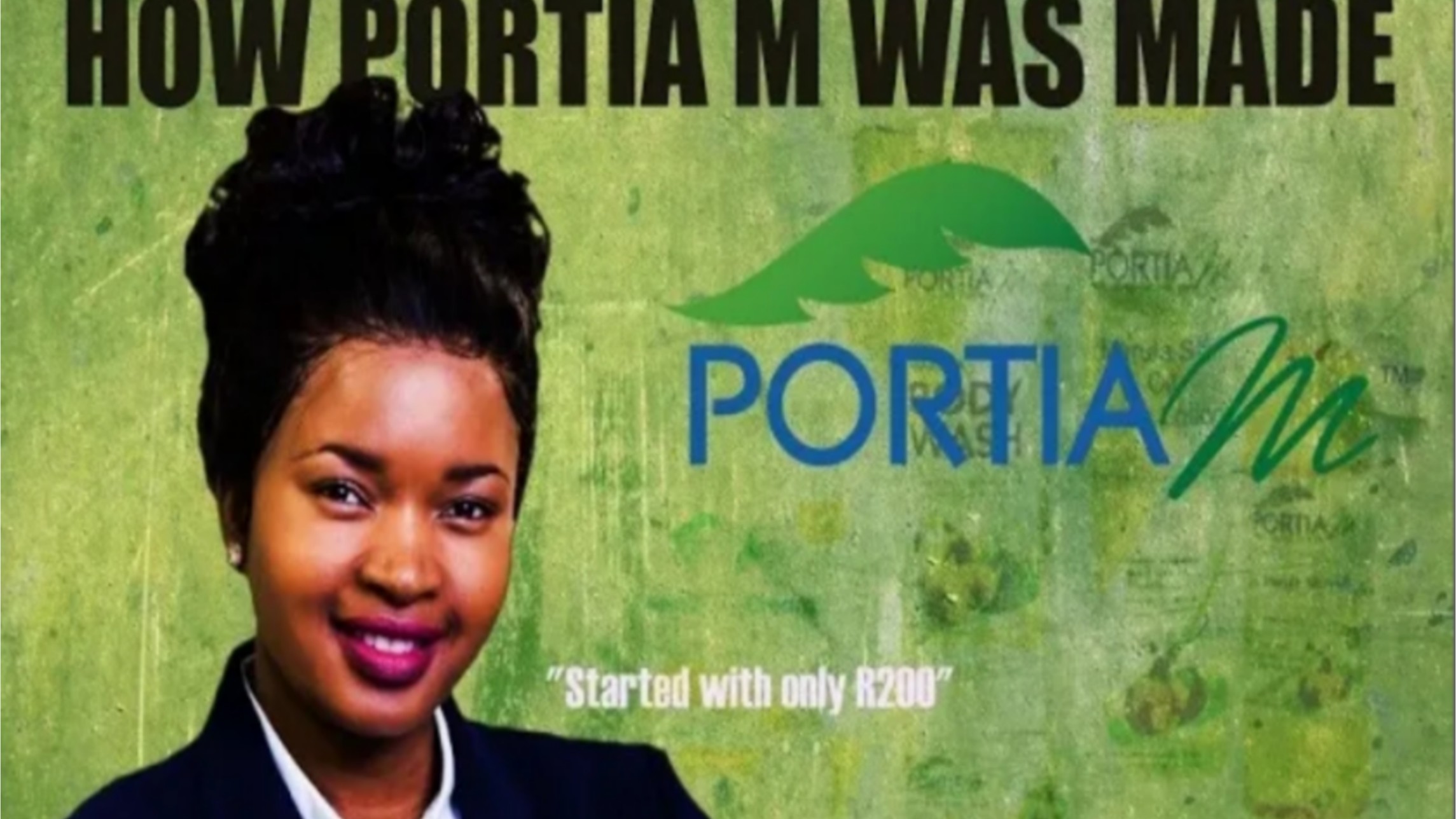
The Portia M brand has become synonymous with affordable skincare in South Africa. Its founder, Portia Mngomezulu, had humble beginnings in Phalaborwa, Limpopo, living with her maternal grandmother.
Background: Portia M
Portia comes from a family of matriarchs who were self-employed and constantly taught her the importance of being her own boss and building something for herself.
She moved to Kriel in Mpumalanga to stay with her parents at the age of eight. While there, she started earning money by making decorative cushions from scraps of material left over from her seamstress mother’s creations. She also plaited people’s hair.
Being the eldest of her mother’s 3 children, she led the way by studying IT at the Tshwane University of Technology and completed the qualification in 2002. She followed that with a certificate in Project Management through Unisa, and then secured an internship at Siemens South Africa, where she worked for 9 years.
The Start of Portia M
After conceiving her first child in 2010, she developed stretch marks. Her husband is from Swaziland, and on one of their visits to her mother-in-law, she told her about marula oil and how its healing properties can heal any skin ailments.
She bought a bottle from the rural women and tried it out. It worked like magic, the oil did wonders for her skin. The results were so impressive that Portia wanted to share it with those closest to her. Investing 200 Rand initially, she bought Marula oil directly from rural women in her hometown of Phalaborwa in Limpopo, bottled it herself and began selling it for 100 rand as a side-business to church members and friends who were pragnant. The profit she made on each bottle was reinvested into her business.
She knew there was an opportunity to build her own brand when the demand for her bottled oil continued to grow amongst friends and on social media.
During this time, she decided to revisit a folder on her computer titled, My Journey To Greatness, whereby she wrote down exactly what she wanted to achieve with her skincare brand.
The business was officially registered in 2011 and named Portia M, because as a Christian, she believed there was greatness in everyone’s name. She thought to herself, if people can buy Elizabeth Arden or Estee Lauder and not even know who they are, or where they come from, why can’t they buy Portia M???
She was adamant from the get-go that she didn’t want to grow a network marketing business, she wanted to compete at a retail level against international giants.
Working on a tight budget forced her to be creative in order to get her product out there, she used her IT skills to advertise on Facebook, encouraging women who had tried her products to re-post photos on Facebook endorsing the product.
Going all out…
Miraculously, customers started taking before and after images and telling their stories. The value of “social proof’ provided by these testimonials has been immeasurable, and one of Portia M’s key selling points: real people, real results.
She emersed herself in research: reading books, articles and watching videos of how she can come up with skincare products using the marula oil.
Having realized there were no products in the retail space made for African skin as Africa’s climate is different from that of Europe, she wanted to formulate something specific to African skin type and climate.
She discovered the marula oil had exceptional skin benefits like her mother in law said: it was rich in antioxidants and omega 3, 6 and 9 fatty acids, which are good for skin hydration. The oil is also effective in soothing severely dry and flaky skin conditions, its remarkable absorbency makes it perfectly suited for all skin types as it doesn’t clog pores.
Her experience working as an IT medical engineer at Siemens with radiologist and other healthcare professionals came in handy during the product formulation stage.
Upon these findings, Portia used innovative measures to formulate the products. One of the founders of Placecol, South Africa’s earliest skincare brand, came on board to assist with more product research and further formulation of the products.
Getting the paperwork right…
She knew right away that getting the paperwork was a crucial step in the growth of her business. Personal care products are subjected to many different tests before being placed on the market for sale.
With the help and encouragement from her husband, who told me not to give up on her dream and passion, she approached the Small Enterprise Development Agency, and asked to have her products tested. Seda paid for the tests to be conducted by the South African Bureau of Standards at the then MEDUNSA University in early 2012. The process took around six months, during which she continued to sell, without taking a cent from the business.
The first three years of production were conducted at home. She made use of her kitchen, later turning her garage into a mini factory as well as an office, while making use of her kitchen utensils and gadgets such as two plate stove, pots and cake mixer to manufacture the products.
Persistence, and the willingness to overcome a wide range of obstacles, usually determines the fate of a company. In Portia’s case, believing that she had the power to achieve whatever she wanted meant that mental barriers such as fear were never an issue.
Portia resigns to build Portia M
For many, leaving a secure job to venture into the unknown world of business, is a scary thought but Portia chose to put faith in her dreams. As production increased, she took the plunge in 2013 and resigned from her job in IT to focus exclusively on her skincare and cosmetics company.
She received a 356 000 rand payout from her previous employer and every cent of it was invested in the business. According to Portia, growing a business organically isn’t easy because you have to be disciplined. There was a time when she only wore one black outfit because that was the only one she had. Every 20 Rand mattered and had to go back into the business.
As you can imagine, she received all sorts of criticism and ridicule but didn’t really care that much because she knew that one day she would have a full range of products sitting on shelves all over the country.
As daunting as the experience was for Portia, she instinctively knew she had made the right decision when she received a call from Mass Mart offering her a scholarship to study at the Gordon Institute of Business Science. The entrepreneur enrolled at the institution for a one year supply development programme in 2014 where she learned the process of planning, organising and analysing business operations in a manner that allows for a successful business.
Retail
While still busy with the course, she also went to see Makro’s skincare buyer whom was impressed with her product besides the packaging part. Despite having little money at that point, she got the packaging correct and was back in two weeks. Makro started her out with five stores, which was a huge breakthrough moment after putting heart and soul into the project.
With this huge breakthrough, the business was able to make connections with other store groups, most notably being listed with 20 Pick n Pay stores, after the personal intervention of Suzanne Ackerman, daughter of Pick n Pay founder, Raymond Ackerman, whom she met during Absa’s Women in Business seminar tour at the Cape Town leg.
Suzanne was impressed by the fact that Portia had tested her products and the barcodes were in place. Through Suzanne as the Transformation Director, she managed to get placed in 20 Pick n Pay stores.
She visited each and every retail franchise in the country, and while some of them said NO, she never took it as an actual NO, instead she worked on increasing the sales through channels she already possessed.
Between 2016 and 2017, her Pick N Pay sales jumped by nearly 2000% and the store list expanded nationally.
It took another two years to convince the buyers for Shoprite and Checkers to place the products on their shelves.
More retailers and independent pharmacies soon followed, today the brand has 40+ facial and body skin care products that are sold in over 2000 retail stores countrywide.
To export the range into other African countries, she has leverages the operations of her partner SA retailers which already have a presence in the continent, the likes of Shoprite, Pick n Pay and others. Because of that, the brand today has a presence in 14 African countries, while employing over 150 staff and has created over 2,000 related jobs in merchandising the products across leading retail channels.
New Factory for Portia M
A second breakthrough for Portia came when she won the DTI’s Emerging Supplier Award in Tshwane, where she met with representatives from The Innovation Hub who eventually offered her factory space for a fraction of the market price. The move to the new premises happened in 2016 and the business rapidly evolved from a garage operation to a 1,400m2 building with state-of-the-art equipment.
In 2017, she was named a National Gazelle, an initiative of the Department of Small Business Development and Seda aimed at propelling the selected top 40 high growth SMEs to the next level through multiple interventions. She won a grant of 1 million rand, enabling her to buy additional manufacturing equipment and a delivery truck, which was an addition to the van her husband had already bought when she was starting out.
The new equipment improved the overall efficiency of the business by reducing repetitive and manual tasks, which freed up employees to do other more complicated tasks.
Standalone Portia M Stores
Recently, the company has been rolling out standalone beauty stores across the country, with 28 up to so far. 19 in South Africa, and 9 abroad.
The standalone stores allow the brand to carry a wider selection of its products in an environment that it controls, providing customers with a fully immersive brand experience. The stores also take advantage of the uniqueness and personalization they offer consumers by testing initiatives that they may not have the freedom to implement within their retail partner stores, the customization process lets the brand express exactly what it wants.
These types of experiences create theatre around the offering and provide consumers with a deeper understanding of the composition of a quality product. Standalone stores make a lasting impression with customers, and change consumers’ expectations for transparency and education offered.
Now the hundred thousand trillion dollar question, how much is the Portia M brand worth altogether?, Well firstly the official answer is that we don’t know for sure and secondly, its a difficult question to answer because Portia M Skin Solutions is a privately registered company and therefore is not liable to release its financial statements for everyone to see.
However, based on numbers that Portia has uttered here and there on articles, shows and during interviews, we can come up with something or better yet, let you formalise your own opinion on the matter.
How Luno Became Successful: The Building of a Crypto Empire
Portia M’s Net Worth
Now as many of you know, the worth of any particular business is an open question. We can only get closer to understanding it by looking at income, making projections and gauging what that business might sell for on the market.
According to an article by the FNB Franchise Leadership Summit that was reposted on the blog section of Portia M’s website, the business had an annual turnover of almost 50 million rands in 2018 generated through its then retail partnerships, independent pharmacies, as well as the online store.
Usually in the product industry, company valuation goes for 3 to 5 times the annual revenue generated. So in the case of Portia M using 2018 revenue alone, the valuation was between 150 million to 250 million rands.
But bare in mind, this was 5 years ago, a lot has happened and a lot has changed since. The company has expanded the product range and also increased its footprint, as well as digital print.
Portia M’s Net Worth Revealed on Mzansi Tycoons
So the valuation is probably more right now taking all things into consideration. In January 2022, DStv’s most controversial and divisive channel, Moja Love, announced a new entrepreneurial show called
The show sees Moja Love CEO Aubrey Tau talking to successful entrepreneurs about how their journey started, the obstacles they faced and how they’re using their success to assist others in their communities.
The second episode of the show visited Portia M founder and during a part of the show, Tau asked her if whether big businesses hadn’t come to buy equity in her company and she answered,
“the first offer was around 60 million rand and I’m like, these people are playing.”
So if 60 million rands was taken as peanuts to buy a percentage stake in Portia M a year or two ago, how much do you think the brand is worth right now in 2023?
Get the latest entrepreneurial success stories, expert tips, and exclusive updates delivered straight to your inbox — Sign up for Entrepreneur Hub SA’s newsletter today!